Many Moons
A Fantasy Opera
In 1963, Young Audiences of New York commissioned Celius to compose an opera to introduce children to this very special form of musical story telling. For the plot he chose James Thurber’s Caldecott award-winning book Many Moons, from which he composed a lively 40-minute opera, which was first performed in schools throughout the New York area by a professional touring ensemble accompanied by the composer. Since then it has been adapted for the stage by collegiate vocal programs.
Link to a Video Recording of the FABULOUS PRODUCTION presented at Picollo Spoleto by College of Charleston Opera:
https://www.youtube.com/watch?v=Z7pfI-giCmk
To peruse the score or make arrangements for producing this opera contact its publisher, G.Schirmer.
Piano-vocal score.
N.Y.: G. Schirmer, 1964
No Chorus.
6 Characters.Orchestra: 14+ (flute, oboe, clarinet (bass clarinet), bassoon, horn, trumpet, trombone, percussion, piano, strings).Parts available for rent. Piano-vocal score: 88 pages. Duration 40 minutes. Licensed performance only.
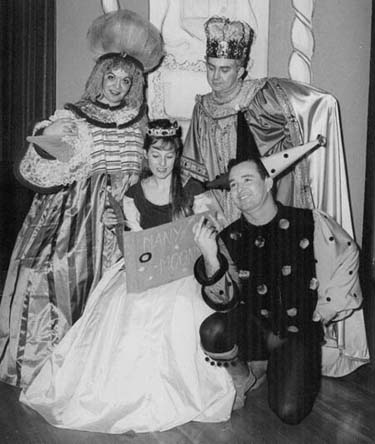
A little princess, in a kingdom by the sea, wants the moon and baffles all her elders in obtaining it.
Requiring only a soprano, alto, tenor, baritone and pianist, Many Moons can be performed in school gymnasiums and on the stage. Recent stage productions include Northwestern College, directed by Doreen Hutchings (2003) and the College of Charleston, directed by Deanna McBroom and Robert Ivey, presented at the 2004 Piccolo Spoleto Festival.
Synopsis: The 10 year old Princess Lenore (soprano) is sick from eating raspberry tarts and believes that the only thing that will make her well is to have the moon. The king (baritone) consults the royal chamberlain, royal wizard and royal mathematician (which can all be played by one alto,) each of which tells him that to obtain the moon is impossible, while eaches' estimation of its distance continues to increase. It is the court jester (tenor) who solves the problem by referring the king to his daughter for an estimation of the moon's size, distance and composition after which he is able to fashion her one the size of a thumbnail out of gold. When the king worries that the princess will catch on and wonder why the moon has reappeared outside her window, the jester refers him to the princess again for an answer. She replies that it has, of course, grown back after being plucked.
THE COMPOSER’S INTRODUCTION TO MANY MOONS
Good morning, children! Before we begin our performance, which will start in just a moment, I want to tell you, very quickly. a little about what you are going to hear.
You know of course that it is an opera, a short opera in one act. The name of it is Many Moons. Some of you have already seen an opera, perhaps, or you may have heard one of the broadcasts of opera from the metropolitan on Saturday afternoons; but for those of you who have never seen or heard an opera, this is going to be a new experience, and you will want to know what to expect.
Now an opera is simply a story in which the characters sing the words instead of speak them. You may wonder what the advantage of this is. The advantage is that when people sing words, they seem to put much more feeling in them, and make them sound much more important than they often really are. Now when you hear the king and the princess in this opera sing about their sadness, and later, their happiness, you will share these same feelings with them, because the music has given their words so much more importance and meaning.
Music can do something else that will surprise you. You know that when two or three or four people are talking together at the same time, no one can possibly make out what they are saying. But in music, it very often happens that two people will sing at the same time. This is called a duet. The surprising thing is that you will be able to understand not only their words, but the way they feel about these words. The same thing happens when three characters sing at once. This is called a trio. Or four – this is called, of course, a quartet. You are going to hear all of these this morning, and my guess is that you will have no trouble understanding what each character is singing.
Music can do a still more interesting thing. It can actually describe characters for you, so that you will be able to guess from their music alone what they are going to look like and how they are going to act, even before they come onto the stage. You are going to see a king, a princess, a jester and three very unusual characters, a royal chamberlain, a royal wizard and a royal mathematician. each one of these has his own music, and I am sure you will recognize them by their music even before you see them.
I am not going to tell you the story of Many Moons, except to say that it is about a little princess who was ten years old , who lived in a palace by the sea and who had a most unusual wish. I’ll not tell you how she got her wish, but will let the characters tell it or rather sing it for you.
This story was written by one of our country’s most imaginative writers, James Thurber, and is the one that is the most loved, both by children and adults. I have written the music for the opera, and I have written it expressly for young audiences, such as you.
Now we are ready to begin, and I am going to start playing you the overture. Most operas have an overture, which is some music to prepare your ears for what is to come, and put you into the right mood. Now this overture will go straight into the opening of the curtain, so you will not have a chance to applaud here. But at the end we hope you will show us by your applause how much you have enjoyed it. And then I will ask the singers to come onto the stage and introduce themselves to you; and if you have any questions that you would like to ask us about the music, the story, the singers, the costumes, or anything else, we will do our best to answer them.
- Celius Dougherty